Mission: Insufferable.
It’s getting harder to tell where Tom Cruise ends, and Ethan Hunt begins – or if there’s even a difference anymore. Mission: Impossible – The Final Reckoning doesn’t so much continue the story as genuflect to its leading man’s compulsion to prove something no one’s asking him to prove. It’s a film less concerned with espionage than existentialism, stitched together by sinew, stunt cables, and a faint whiff of desperation.
Originally conceived as Dead Reckoning Part Two, this final entry has undergone a reckoning of its own, the kind of identity crisis usually reserved for franchise reboots. Retitled and reshaped after its predecessor underperformed and left audiences dangling off a narrative cliff no one was particularly eager to climb back up from, The Final Reckoning tries to reassert control – over tone, over story, and most of all, over perception. But in trying to fix the sins of the past, it only magnifies them.
The ill-defined AI threat – still dubbed “The Entity,” as though someone forgot to name it before the table read – is back and still managing to be the least interesting all-powerful force in cinema. It’s less Skynet, more blue screen of dearth of ideas. This time, Hunt and his IMF team (what’s left of them) race against time, gravity, and Esai Morales’ risibly unconvincing nemesis to prevent a future where machines rule and human free will is forfeit. But while the film gestures at themes of truth, trust, and technological determinism, it doesn’t actually care about them. They’re just plot-shaped scaffolding, a way to hang another series of elaborately choreographed set-pieces designed to leave your jaw slack enough to forget the story’s missing.
What replaces narrative tension is a kind of terminal gloom. The film is preoccupied with apocalypse, invoking the phantom apparition of a dirge of missiles and mushroom clouds and never really letting the mood lift from that point on. It’s the opposite of escapism – a po-faced, glowering blockbuster that trades thrills for existential dread. Most of it unfolds in dim tunnels, dank caverns, and murky deep-sea locations, making this the darkest entry in the series in both tone and literal lighting.
The Final Reckoning notably struggles to find anything meaningful for its ensemble to do, seemingly terrified that giving any character too much focus might pull attention from its star (still, I suspect, the real reason Rebecca Ferguson was written out). The result is a supporting cast reduced to exposition machines and occasional stunt facilitators yet that doesn’t stop the film from immediately replacing anyone it kills off with a largely anonymous substitute, slotting them into the team as though personality were an optional extra or peppering the cast with big-name pointless cameos. The ensemble’s disposability feels baked into the script – a symptom of a franchise so singularly focused on Cruise’s heroics that everyone else may as well be wearing red shirts.
It doesn’t help that half the runtime is spent in shadowy rooms where characters murmur variations of the same plot points at each other like a high-concept séance as an endless parade of characters takes their turn trying to explain the plot and why it matters. None of them succeed. The script is particularly bad, stuffed with egregious lines like “the destruction of cyberspace” (the 90s called, they want their technobabble back) that sound portentous in the moment but collapse under even cursory scrutiny. You can always tell a good film by how often it grinds to a halt so characters can solemnly restate the plot, re-explain the villain’s motivation, and emphasise the stakes. By that measure, The Final Reckoning is a masterpiece.
At the heart of it all is Cruise – clenched, committed and unwaveringly convinced of his ascent to cinematic sainthood. But, like its leading man’s face, Mission: Impossible has grown puffy and bloated (and whoever edited this needs to be barred from ever winning an editing Oscar). The film treats him less like a character and more like an object of worship. In a slow and overly talky action-thriller, most of that talk is other characters lavishing screen time by talking about how great Ethan Hunt is.
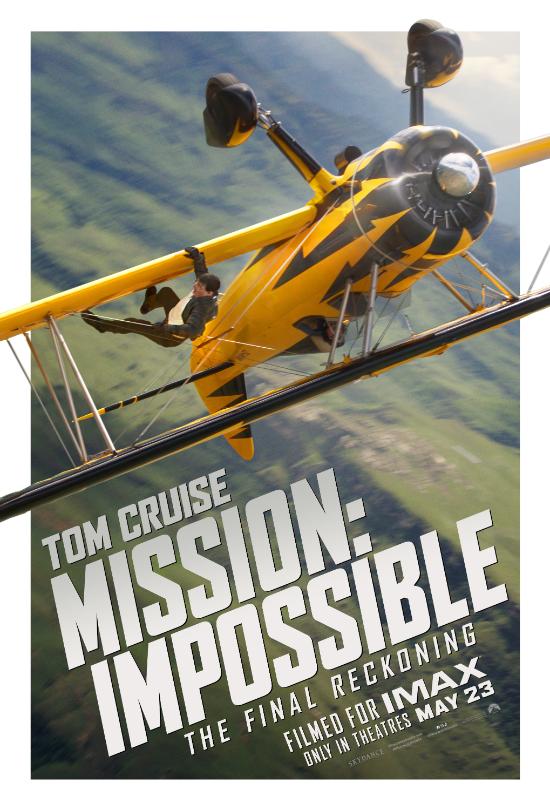
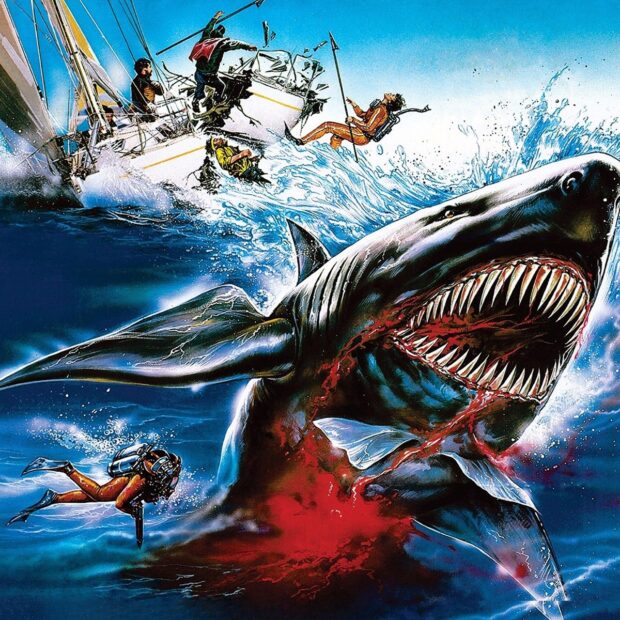
Each contrived stunt – a twenty minute ‘silent movie’ diving sequence that tells the physics-defying deep sea nonsense of Meg 2: The Trench to hold its beer, the plastered-all-over-the-posters and trailer biplane battle and all the running – so, so much running – play less as essential narrative beats than a promotional sizzle reel for Cruise’s real-life refutation of actuarial logic. The Mission: Impossible films used to be about impossible missions. Now they’re about how often Tom Cruise can thumb his nose at death before the credits roll.
And yet for all the film’s doom-laden grandeur, the stakes boil down to cartoon simplicity. The fate of humanity hinges on Ethan clicking two gizmos together – one of which is left, inexplicably, in the pocket of an incapacitated friend where it’s easy pickings for the bad guys. We’re told again and again that Ethan Hunt is the world’s last, best hope. But no one dares mention that he’s also the reason all these MacGuffins end up in enemy hands in the first place.
Christopher McQuarrie directs like a man handcuffed to a metronome – the rhythm is relentless, but not always meaningful, trapped as he is between his star, Tom Cruise and his producer…er, Tom Cruise. He has an undeniable instinct for the spectacular, but the emotional notes come out flat because he’s forced to focus the lens through the omnipresent prism of Ethan Hunt. The script, co-written with Erik Jendresen, tries to course-correct the knotty, overambitious and underwhelming sprawl of Dead Reckoning Part One with a tighter focus, but there’s nothing that can redeem an enemy as nebulous and ill-defined as “The Entity” so what we get ends up feeling like a nostalgic buffet reprising better, earlier Mission: Impossible movies. Maybe that’s why the film has so many flashbacks? To disguise the fact that much of the “new” stuff is just rehashing previous set pieces.
Worse still, The Final Reckoning attempts even more of the brazen retconning that blighted its predecessor. It’s still trying to make “The Choice” happen – the single most pointless ingredient these last two movies have introduced because it doesn’t pay off anywhere – but now it’s even retconning its immediate predecessor by telling us the sinking of the Sevastopol we saw at the start of Dead Reckoning Part One took place not in 2023 but in 2012. Oh, and the submarine didn’t actually contain “The Entity” after all, just its factory reset cartridge. All the course-correcting is in service of a bone-headed attempt to tie everything back to a single antagonist, something that didn’t work for Bond and manifestly isn’t working for Mission: Impossible. At least Bond had the good grace to die of embarrassment after No Time To Die but Ethan Hunt seems insteaad to be rewriting the gospel to cement his place as cinema’s Thetan messiah.
The Final Reckoning wants to be a swan song, but it’s stuck in an encore that no one requested. It plays the hits, sure – masks, marathons, mutual betrayals – but there’s little sense of evolution, of closure, or even consequence. If this is indeed Ethan Hunt’s last mission, it’s a strangely hollow farewell, more concerned with burnishing Cruise’s legacy than resolving anything meaningful about the character. The repeated, reverent montage of past instalments makes it clear: this isn’t just a movie, it’s a self-anointed lifetime achievement award reel masquerading as a plot.
Perhaps that’s fitting. The film’s real mission was never about defeating a digital god or saving the world. It was about proving that its star could still outrun time, physics, and the industry itself.