#DoomsdayPrep: Ice, Ice, Nepo-Baby.
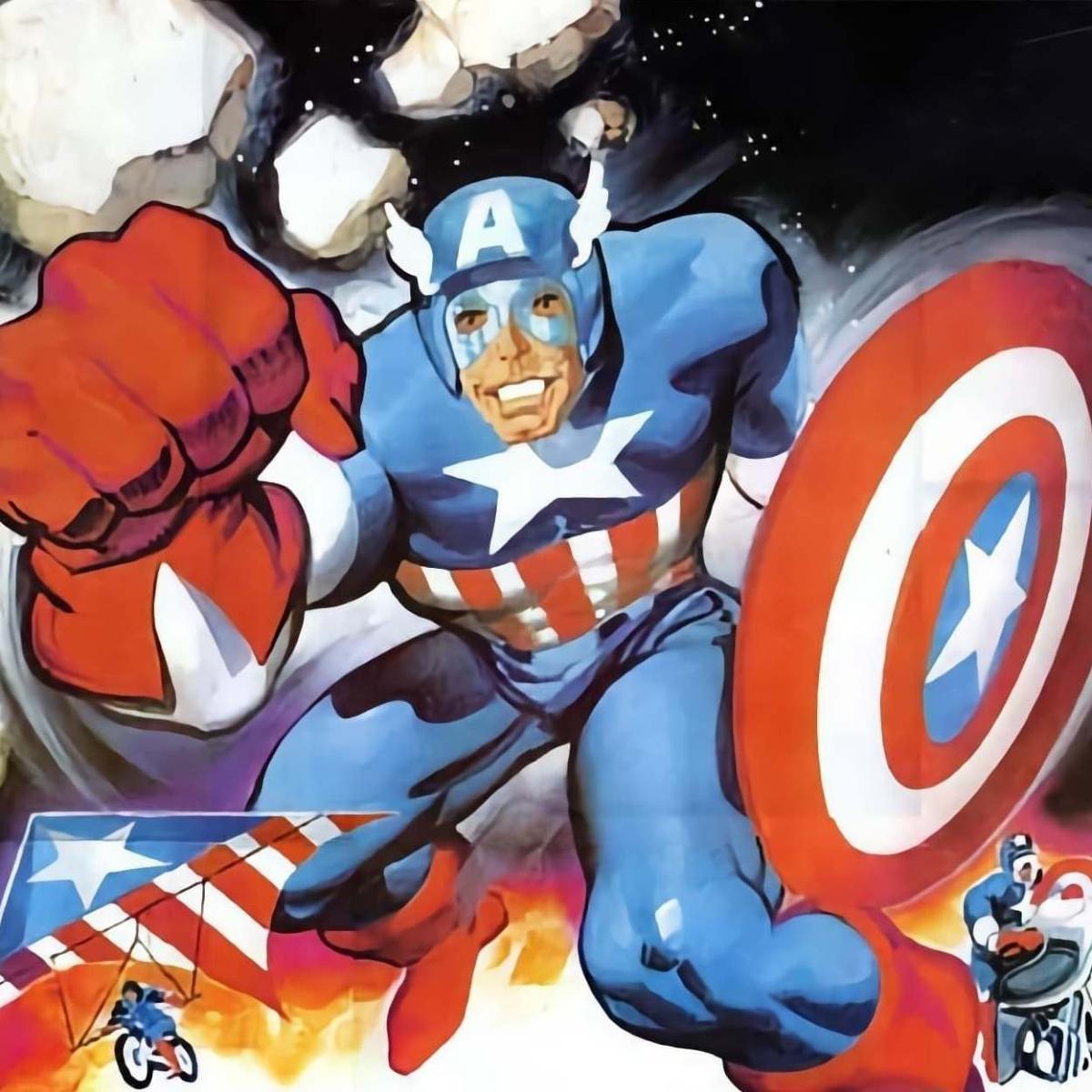
1990’s Captain America may do enough to at least be a step forward from Reb Brown’s disastrous 1979 deuce, but it still reminds us that before Marvel became a global entertainment powerhouse, it was a source of bargain-bin desperation for producers like Menahem Golan and Yoram Globus. Rescued from the wreckage of Cannon Films like a World War II super soldier from the ice Captain America was transferred to 21st Century Film Corporation and director Albert Pyun was tasked with manifesting a star-spangled icon on a budget that would scarcely cover the catering on for one of Pete Hegseth’s press conferences. The result is a work of profound tonal dissonance, where the genuine pathos of a man out of time is consistently undermined by the sight of Matt (son of the JD) Salinger’s Steve Rogers sporting rubber ears glued to the side of his poorly cut latex mask and a script that wants to be a globe-trotting espionage thriller but only has the resources of a regional car commercial.
Salinger’s portrayal of Rogers lacks the bovine immobility of Reb Brown or the stoic nobility of Chris Evans, settling instead for a bewildered, slightly gormless quality that actually suits a character snatched from the 1940s and dropped into the cynicism of the early nineties. When he isn’t being shoved into the deep-freeze, Salinger’s Rogers spends a significant portion of the film faking illness to steal cars from unsuspecting civilians, a character choice that suggests this incarnation of the Sentinel of Liberty’s primary superpower is grand theft auto. Less a tactical genius and more a well-meaning lummox, Rogers wanders through a plot that involves a Red Skull (inexplicably reimagined as an Italian fascist named Tadzio de Santis) acting as a terrorist for hire for the world’s fossil fuel lobby (the one aspect where the film feels ahead of its time rather than catching up). Scott Paulin’s performance is as broad as his character’s skull is red even if the choice to transform him from a hideously scarred, crimson-faced fascist into a suave, piano-playing industrialist in the film’s second half remains one of the more baffling creative pivots in superhero cinema. Like Doctor Doom in Roger Corman’s unseen The Fantastic Four, Rudin’s Skull (Red or Otherwise) is the best thing in a largely mediocre movie. He understands the comic book assignment and sinks his teeth into the scenery and awful dialogue with a gusto that’s almost admirable.
In common with many Golan/ Globus productions, the production history of Captain America is a saga of truncated visions and financial evaporation, evident in the various cuts that have trickled out into the cultural ether over the decades since the film was…well, finished seems a little too generous. The theatrical version – the film received a theatrical release internationally but was relegated to straight-to-video in the USA and the later “Director’s Cut” reveal a film struggling to find its rhythm. Pyun, a director not renowned for his ability to craft anything but workmanlike low budget fare, clearly wanted to lean into the tragedy of Rogers’ lost life, but the script – and the capabilities of his lead actor – continually drags him back toward low-stakes action beats. The middle act, where Rogers gallivants across Europe with his former flame’s daughter Sharon (Kim Gillingham), feels particularly disconnected, a series of episodic encounters that fail to build any meaningful momentum and it’s here that the film’s budgetary constraints become most apparent – and where it most closely resembles its 1970s predecessors, as world-altering conspiracies are discussed in what appear to be deserted Yugoslavian office parks.
It wastes some great supporting talent in the process: Ronny Cox is great value as President Tom Kimball, a man whose childhood encounter with Rogers should provide the film’s emotional spine, Darren McGavin appears as General Fleming to provide the requisite military bluster and Ned Beatty is briefly present as Sam Gloss, a character whose primary function is to bridge the gap between the 1940s and the present day with exposition and potentially remind the audience of how fond they were of Superman: The Movie.
The film’s laudable insistence on focusing on an environmental subplot involving the Red Skull’s ill-defined organisation feels like an attempt to stay “current,” but it only serves to dilute the central conflict between the two super-soldiers, that by the time its eventually referred to, it doesn’t really work as a character arc. The action choreography is notably sluggish, although the shield, Captain America’s iconic accessory, is handled a little better here than the obviously plastic throwing disc of Reb Brown. It’s still laughably slow and occasionally wobbly but at least it moves and interacts with its targets like it has physical substance and kinetic potential. There is no sense of the cunning or tactical brilliance one associates with either Cap or the Red Skull and instead, we get a man in blue spandex jogging through the coastal battlements of an old castle while a rejected Dick Tracy villain sprays the scenery with an Uzi. The score by Barry Goldberg attempts to mitigate the paucity of the production, creating a heroic sweep that the visuals can rarely match, but there are moments, specifically Rogers’ initial transformation and his return to his childhood home, where a genuine sense of melancholy breaks through the low-budget shortcomings.
Despite these myriad shortcomings, there is a scrappy, sympathetic likeability to 1990’s Captain America. It’s trying, really hard to be at least a fun watch but there’s just no getting away from the fact it’s the product of the tail end of an era where superhero films were viewed as cheap properties to be farmed out to whoever could pay the licencing cost. After all, this came out just a year after Tim Burton’s Batman, a film which redefined the potential for caped heroes and box office bonanzas. Captain America fails as an adaptation by any traditional metric, but it remains an interesting relic of a time when the biggest threat to Steve Rogers wasn’t Thanos, but a lack of completion bond insurance and a prosthetic department with a job lot of latex ears.