A slowpocalypse that leaves the audience behind.
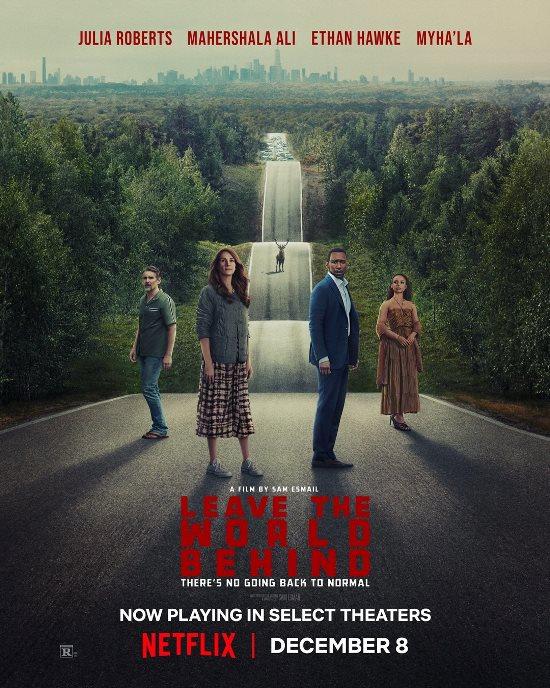
There’s an inescapable smugness to Leave the World Behind, the kind that oozes from projects convinced they’re saying something profound simply because they’re whispering. Sam Esmail’s apocalypse-by-attrition film feels less like a cohesive story and more like a faux-prestige curation of ominous vignettes stitched together in the editing suite and sent out the door with the Netflix Original sticker slapped on top.
You can almost see the original shape of what it might have been: a limited series pitch deck gathering dust until someone decided it could be bolted into a two-hour-plus feature. The episodic pacing is still there – scenes that start with promise, linger too long, and then dissolve into the next moment of mood without ever bothering to explore the developing tension or deliver resolution. It’s a film that feels like a series that constantly teases the next big reveal… but then cuts to credits. Repeatedly.
Julia Roberts plays Amanda with a brittle, closed-off energy that could be an intentional character choice or just the result of unclear direction. There’s a carefully calibrated frostiness between her and Mahershala Ali’s character, G.H. Scott, but whether that’s meant to be read as classism, latent racism, or simply rich-people nerves when the world starts wobbling is never truly articulated. I’m all for ambiguity in storytelling but Leave The World Behind seems too delighted by the questions and utterly disinterested in the answers. Ethan Hawke, meanwhile, seems to have wandered in from another, far less anxious movie but has little to play off and mostly seems frustrated to find himself in such dramatically inert surroundings.
Perhaps it’s because the film treats its cast as mere set-dressing. Instead, the camera work tries desperately to be the star – wide, off-centre shots designed to unsettle but ultimately just calling attention to themselves juxtaposed with clumsy zooms and close-ups. What worked as part of Mr. Robot’s paranoid tapestry feels here like Esmail elbowing you in the ribs at every turn. Every awkward angle, every lingering shot of empty corridors, every dramatic drone shot of people running in the distance – all of it screams “This Is Symbolic!” without ever bothering to explain what all the symbolics is about.
The real kicker is that the trailer already gave away every one of the film’s big moments, leaving acres of pensive silence and meandering tension completely unhinted at. All the striking visuals and headline shocks are used up before you’ve even pressed play, and what’s left is mood without momentum. Dialogue flits between ominous platitudes and tortuous pontificating, with moments that feel like they’ve been reverse-engineered to appear in out-of-context clips on social media. Scenes end abruptly, or worse, slide into indulgent montage sequences soundtracked by needle-drops that feel curated for clout rather than narrative purpose. The opening auditory salvo – Joey Bada$$’s THE REV3NGE – is a prime example of the disjointed soundscape: energetic, cheeky, but ultimately hollow once the irony wears off and its clear the film is too lethargic to rise to the promise of the song, delivering instead a slow trudge towards oblivion, as the mood sinks steadily and irreversibly into melancholy torpor. Even the moment when the family encounter a highway blocked by self-driving Tesla after self-driving Tesla careering dangerously down the road and crashing calamitously – the film’s only sign that perhaps normality hasn’t been entirely eradicated – fails to lighten the mood.
You get the sense that if this had been a six-episode series, there might have been room for nuance, for Amanda’s discomfort to curdle into something more revealing, for G.H.’s cryptic warnings to land with actual weight, and for the slow apparent collapse of society to unfold with more than just a catalogue of unsettling news broadcasts. Instead, everything is compressed and flattened, and all we’re left with is a collection of Pinterest-level symbolism that point to bigger ideas that never really get explored.
Leave the World Behind ends exactly as you expect it to: with a shrug, and a smirking callback to Friends, even though the series it homages the most is Black Mirror. Esmail is no Charlie Brooker, though, and for all the inscrutable dystopian mysticism deployed, this slowpocalypse never feels remotely real or, oddly, threatening beyond a mundane kitchen-sink-drama sort of way and ultimately lacks a final punchline that would make it all worthwhile. I just don’t think the end of civilisation as we know it should be so…forgettable.