Brosnan offers ham on the bone for King’s dark conspiracy.
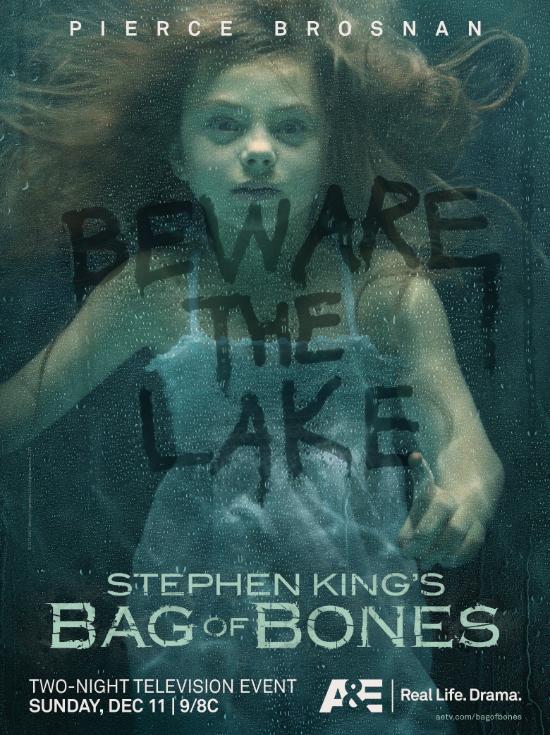
Grief is one of the oldest ghosts in Stephen King’s arsenal and in Bag of Bones, it seeps into every room, bleeds into dreams, and curls around the edges of memory until the past and present collapse in on each other. It’s King in mournful, melancholic mode; a story not of sudden shocks or creeping dread, but of sorrow turned septic and secrets buried for far too long. Adapted as a two-part miniseries in 2011, Bag of Bones trades the thunder of supernatural horror for something slower, sadder, and undercut with unease: a haunted house story where the real damage is already done, and the spirits are just trying to clean up the mess.
Mike Noonan (Pierce Brosnan), a bestselling author, loses his wife Jo (Annabeth Gish) suddenly (to that most egregious of TV tropes, a speeding vehicle that makes no attempt whatsoever to slow down) and retreats to their remote lakeside cabin in Maine to grieve and, hopefully, write again. Instead, he finds himself drawn into a custody battle between local widow Mattie Devore (Melissa George) and her powerful, controlling father-in-law Max (William Schallert), while plagued by dreams and visions connected to the tragic fate of blues singer Sara Tidwell (Anika Noni Rose) decades earlier. As secrets rise to the surface, so does something far older, and far more vengeful, than Mike expected.
There’s a kind of twisted genius in casting Pierce Brosnan as a grieving, creatively paralysed author tormented by loss, lust, and literary ghosts and putting him in the hands of a director like Mike Garris. Through some unknowable alchemical process, their mutual mediocrities somehow elevate each other and what shouldn’t work somehow does. Brosnan approaches the role of Mike Noonan with the strained intensity of a man doing pull-ups over a tank of sharks and shit. When Noonan is calm and collected, Brosnan is note perfect, but the moment he’s called upon to emote in anger or fear, he dials it up to the max and delivers that trademark strenuous haminess that lets you know acting causes him physical pain. Yet despite the overwrought execution, the emotional tone he strikes doesn’t feel wholly out of step with the material. If anything, it fills the atmospheric gaps that the direction leaves hollow.
Bag of Bones sometimes struggles to find its shape. The adaptation condenses a long and thematically layered novel into two episodes, and the compression is most often felt in every beat that arrives without buildup as plot developments appear suddenly, character arcs are abridged, and revelations are dispensed like late breaking bullet points rather than lived experience. What the adaptation preserves in surface fidelity – names, events, chronology – it loses in the psychological depth that gives the novel its strange, oppressive weight, a weight that’s only inconsistently evoked onscreen.
Mick Garris has made a minor cottage industry out of adapting King with caution, and Bag of Bones might be the best adaptation he’s directed, although that’s faint praise given his previous efforts. His direction here is clean, deliberate, and competent. The story’s horror comes not so much from the supernatural but from dark deeds and darker conspiracies and so freed from the need to envision the uncanny, he settles into a comfortable, contemporary groove.
Brosnan might veer wildly between debonaire and deranged but he’s surrounded by a supporting cast who understand the assignment with more subtlety. Anika Noni Rose brings a sharpness and fury to Sara Tidwell that makes her limited screentime hit harder than expected and Melissa George gives a likeable performance as Mattie, even though her role feels trimmed down to functional necessity. William Schallert, though, leans comfortably into the role of Max Devore, his genteel menace just acidic enough to sell the corruption beneath the surface, aided and abetted by the imperious Rogette Whitmore, played with menace and relish by Deborah Grover.
The adaptation does attempt to retain King’s thematic concerns: artistic paralysis, the danger of buried histories, the spectral pull of trauma, but its running time stops it engaging with them in full. The deeper horrors of Bag of Bones, racism, sexual violence, and generational complicity, are acknowledged only in passing. It may be a flawed adaptation, but it is a recognisably faithful one and while it doesn’t elevate the material, it doesn’t betray it either.